What the credential is, and who needs it
The NERC Glossary puts the Reliability Coordinator at the highest level of authority for reliable operation of the Bulk Electric System. It holds the Wide Area view and the authority to prevent or mitigate emergencies, in next-day analysis and in real time. Its purview is wide enough to calculate IROLs, which can rest on transmission systems beyond any one Transmission Operator's view.
PER-003-2 sets who has to hold it:
- Reliability Coordinator positions: RC certificate only. The standard calls it the "Reliability Operator" certificate, a name the program manual also uses for the RC credential.
- Transmission Operator positions: RC, BT or TO.
- Balancing Authority positions: RC, BT or BI.
The RC certificate is the only one accepted at all three desks. Someone without a certificate can do the work of a real-time position only under the direct supervision of a certified operator stationed at that position.
It also carries the most renewal hours: 200 CEHs every three years, against 160 for BT and 140 for TO and BI. And it leaves the most room at renewal: an RC holder can renew to any other credential once they have the hours for it. Going the other way, from BT to RC, takes the RC exam.
Exam format and delivery
- Register and pay in SOCCED, NERC's certification database. The fee is $700. Eligibility runs 365 days from payment and covers one sitting. You can switch to a different exam type inside that window.
- Schedule with Pearson VUE through the link in your SOCCED account, at least 24 hours ahead. No same-day booking. Reschedule or cancel at least 48 hours out to keep the fee.
- Arrive at least 30 minutes early with two current IDs. One must be government-issued, with your photo and signature.
- On the day: a 15-minute tutorial, then a non-disclosure agreement you must accept, then three hours on the clock. 140 multiple-choice questions on a computer.
- No calculator, watch, phone or notes of your own. You get on-screen basic and scientific calculators, plus a noteboard and a marker. The clock keeps running through a restroom break.
- Result: a pass/fail report at the end of the exam, and a link to it by email.
How scoring works
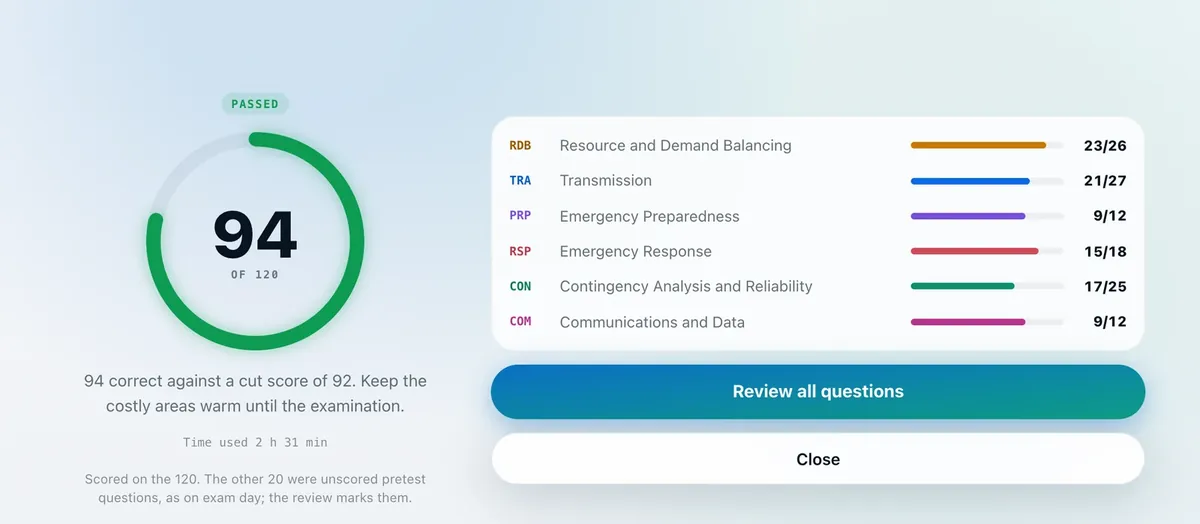
The RC exam is scored by cut score: the number of correct answers needed to pass, out of the 120 scored questions. It's 92. A panel of practitioners sets it, judging every question against a definition of minimum acceptable competence. Every exam form is built to the same difficulty. The cut score has been 92 since June 1, 2020, when it went up from 89.
Three things follow:
- You're counting, not averaging. 92 right passes and 91 doesn't. NERC publishes it as a count, so train to the count.
- Twenty questions are experimental. They're mixed in, unscored and unmarked, and every question goes through that pilot slot before it's ever scored. You can't skip them, so work all 140 at full effort.
- Only right answers count. A blank scores the same as a wrong answer, so leave nothing blank.
The RC content outline
Six domains, 31 knowledge areas, 120 scored questions. This is the table from NERC's outline (effective June 1, 2023). Grid Prep samples a mock exam from it question for question. Each area links to its free practice questions.
What stands out on RC:
- Transmission (27) and Contingency Analysis and Reliability (25) are 52 of the 120. All five contingency areas are worth 5 each: contingency analysis, state estimators and network tools, acting on the results, SOLs and IROLs.
- Against BT (same 120 questions, same cut of 92), RC carries 5 more in Contingency Analysis and Reliability and 5 fewer in Resource and Demand Balancing. System Restoration is 5 on RC and 4 on BT.
- Communications and Data is 12 on every one of the four exams. So is Emergency Preparedness on RC, BT and BI.
How Grid Prep maps to the RC exam
- Mock exams at exam pace. On the web, a full RC mock is the whole paper: 140 questions in three hours. The 120 scored ones follow the per-area counts above, 5 from IROLs, 2 from Loss of Control Center and so on, and 20 unscored questions are mixed in, as on exam day. Flag and return, no feedback until you submit.
- Pace it like the real thing. That is about 77 seconds a question. A mock in the app gives the 120 scored questions the same three hours, so there aim to finish in about 2 hours 34 minutes.
- Readiness on the RC weighting. IROLs carry 5 questions on RC and Energy Sources 2, so your IROL score moves the RC figure two and a half times as much. The figure reads as a projected score out of 120, beside the cut of 92.
- Weak areas ranked for RC. Each area's estimated loss is (1 − your score) × its RC weight. RC has nine 5-question areas, and any of them left untouched tops the list at −5.0.
- The bank behind it: 225 questions in Contingency Analysis and Reliability, 261 in Transmission and 177 in Emergency Response, out of 1,224. Every answer also counts toward BT, TO and BI, so moving credentials later doesn't reset you.
- In the app: the Control-Room Simulator has an RC desk, and the generated one-line comes with an N-1 contingency report to read for the worst contingency and the post-contingency margin. The simulator is a study aid. It isn't NERC-approved and earns no CEHs.
How to prepare for the RC exam
A plan, not a promise. Adjust the weeks to your shifts.
- Start from the two documents NERC points to: the RC content outline and the reference list in the exam resource materials. That list puts the Glossary and the BAL, COM, EOP, FAC, INT, IRO, PRC, TOP and VAR standards first, then named chapters of Power System Operation (Miller and Malinowski) and the EPRI Power System Dynamics Tutorial.
- Take a baseline. Run a Blueprint Sprint (20 questions at the RC weighting) or the free 30-question taster. Read "Where the marks are going", not the raw score.
- Start where the questions are. Contingency Analysis and Reliability (25) and Transmission (27) first. Read the IRO, TOP and FAC standards as you go. The reference under each explanation names the standard and requirement where there is one.
- Smart Review every day you study. Fifteen questions, misses first. It keeps the early areas from fading while you work the later ones.
- A full mock exam once a week from the midpoint. Keep to exam pace: 140 questions in three hours, about 77 seconds each. Review every miss against its reference, then drill the top two areas on the weak list.
- Last week: one more full mock, Missed Questions until it's empty, and the Library cards for the numbers.
On exam day: answer every question, flag and move on rather than stall, and keep about 77 seconds a question.
Questions
RC exam FAQ
How many questions are on the NERC RC exam?
- 120 are scored and 20 are experimental questions that don't count. You aren't told which are which.
What is the passing score for the RC exam?
92 correct out of the 120 scored questions. It's a cut score, a count of correct answers, not a percentage. It has been 92 since June 1, 2020.
Can I get real past RC exam questions?
No. NERC keeps its exam questions confidential, and candidates who share them can lose the credential. NERC's own advice is to study from the content outline and its reference list. Grid Prep's questions are original, written from the published outlines, Glossary and Reliability Standards.
I hold BT. Can I switch to RC at renewal?
No. Going from BT to RC takes the RC exam. Going the other way is open: an RC holder can renew to any other credential once they have the hours for it.