What the credential is, and who needs it
BT covers the work of two functional entities. In the NERC Glossary, the Balancing Authority integrates resource plans ahead of time, keeps Demand and resources in balance in its area, and supports Interconnection frequency in real time. The Transmission Operator is responsible for the reliability of its local transmission system and operates or directs the operation of the transmission Facilities. Interchange, in the Glossary, is energy transfers that cross Balancing Authority boundaries.
PER-003-2 sets where each certificate is accepted:
- Transmission Operator positions: RC, BT or TO.
- Balancing Authority positions: RC, BT or BI.
- Reliability Coordinator positions: RC only.
So BT is accepted on both the BA and TOP desks, and not at the RC desk. A certified operator stationed at the position must directly supervise anyone without a certificate.
Renewal is 160 CEHs every three years. At renewal, a BT holder can move to TO or BI once they have the hours for it. Moving up to RC takes the RC exam.
Exam format and delivery
- Register and pay in SOCCED. $700 buys one sitting, and eligibility runs 365 days from payment. You can change the exam type inside that window, for example from BT to TO. More on fees, eligibility and booking.
- Book with Pearson VUE through your SOCCED account, at least 24 hours ahead. Reschedule or cancel at least 48 hours out to keep the fee.
- Arrive at least 30 minutes early with two current IDs, one government-issued with your photo and signature.
- The sitting: a 15-minute tutorial, the non-disclosure agreement, then three hours for 140 multiple-choice questions on a computer.
- Bring nothing to work with. No calculator, watch, phone or notes. On-screen basic and scientific calculators, a noteboard and a marker are provided. A restroom break doesn't stop the clock.
- Result: a pass/fail report at the end of the exam, with a link to it by email.
How scoring works
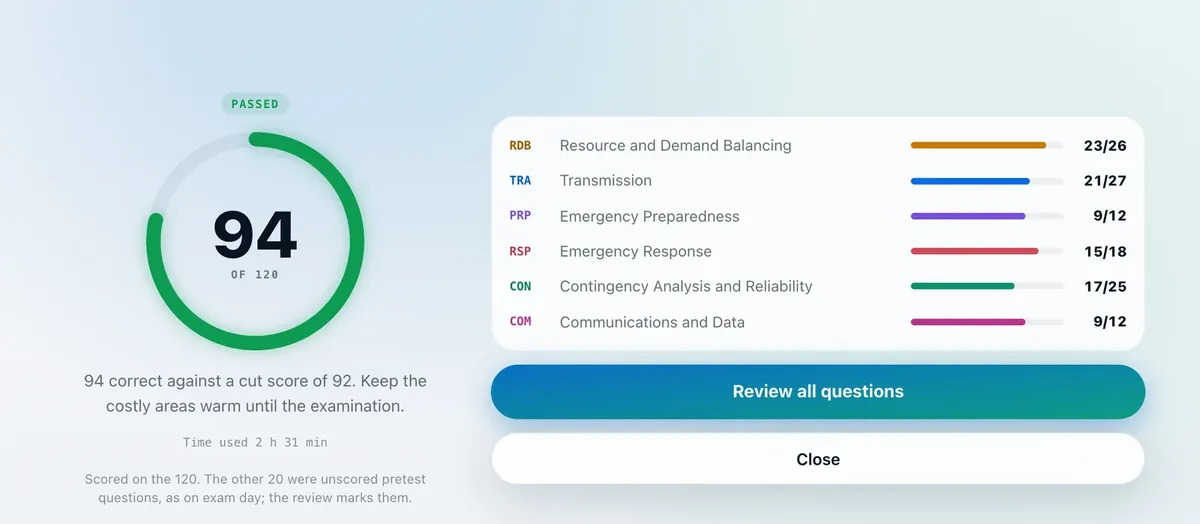
BT is scored by cut score: 92 correct answers out of the 120 scored questions. A panel of practitioners sets it, judging each question against a definition of minimum acceptable competence. Every exam form is built to the same difficulty. The BT cut score has been 92 since June 1, 2020, when it went up from 89.
- It's a count. 92 passes and 91 doesn't. No percentage is involved.
- Twenty of the 140 are experimental: unscored, unmarked and mixed in. Work every one as if it counts.
- Only right answers score. A blank and a wrong answer both score zero, so answer everything.
The BT content outline
From NERC's BT outline, effective June 1, 2023. A Grid Prep BT mock exam draws exactly these counts. Each area links to its free practice questions.
What stands out on BT:
- Resource and Demand Balancing (31) and Transmission (28) are 59 of the 120. Both halves of the desk carry weight.
- Five areas carry 5 each: Frequency, Voltage and Reactive, Reconfiguration and Switching, Operating Limits and Transmission Equipment.
- Against RC (same 120 and same cut of 92), BT carries 5 more in Resource and Demand Balancing and 5 fewer in Contingency Analysis and Reliability. Switching is 5 on BT and 4 on RC. System Restoration is 4 on BT and 5 on RC.
- Nothing is light enough to skip. Every area carries 2 or more, and 29 of the 31 carry 3 or more.
Try a BT question
From Resource and Demand Balancing, the heaviest domain on BT at 31 of the 120 scored questions. Reserves alone carries 4.
The Most Severe Single Contingency is the Balancing Contingency Event producing the greatest MW loss of resource output used to meet which obligations?
- A. Firm Demand and export obligation
- B. Firm Demand and Regulating Reserve
- C. Native Load and Contingency Reserve
- D. Total Demand and Interchange schedules
Show the answer
Answer A Firm Demand and export obligation
The definition measures the greatest loss of resource output used to meet Firm Demand and export obligation. Reserve products are what the Most Severe Single Contingency sizes, not part of the load it is measured against.
Reference: NERC Glossary - Most Severe Single Contingency
How Grid Prep maps to the BT exam
- Mock exams at exam pace. On the web, a full BT mock is the whole paper: 140 questions in three hours, the 120 scored ones at exactly the per-area counts above and 20 unscored questions mixed in, as on exam day. Flag and return, no feedback until you submit.
- Pace it like the exam. That is about 77 seconds a question, and the app's mock runs the same way as the web: all 140 questions in three hours, 20 of them unscored.
- Readiness on the BT weighting. Your projected score out of 120 sits beside the cut of 92. Frequency moves it more on BT (5) than on RC (4).
- Weak areas ranked for BT. Estimated loss is (1 − your score) × the BT weight, so an untouched 5-question area shows −5.0 and tops the list.
- The bank behind it: 327 questions in Resource and Demand Balancing and 261 in Transmission, out of 1,224. Every answer also counts toward RC, TO and BI.
- On the web and in the app: the Control-Room Simulator has BA and TOP desks. The simulator is a study aid. It isn't NERC-approved and earns no CEHs. One scenario is free in your browser; Full Access opens all ten. About the simulator.
- In the app: the AGC control board leaves the ACE for you to work out, and the generated one-line comes with an N-1 contingency report.
How to prepare for the BT exam
- Start from NERC's two study documents: the BT content outline and the reference list in the exam resource materials. That list puts the Glossary and the BAL, COM, EOP, FAC, INT, IRO, PRC, TOP and VAR standards first.
- Baseline: a 20-question BT Blueprint Sprint, or the free 30-question taster. Read the weak-area list, not the score.
- Split the desk. Alternate Resource and Demand Balancing (BAL, INT and the arithmetic of Area Control Error) with Transmission (FAC, TOP and VAR). Neither half can carry the other at 31 and 28.
- Smart Review each study day. It keeps the half you aren't working this week from going stale.
- From the midpoint, a full BT mock every week. At exam pace: 140 questions in three hours, about 77 seconds each. Review every miss against its reference, then drill the top of the weak list.
- Final week: a last full mock, empty the Missed Questions set, and run the Library cards for the numbers.
On the day: about 77 seconds a question. Flag what stalls you and come back to it, and leave nothing blank.
Questions
BT exam FAQ
How many questions are on the NERC BT exam?
140 questions, 120 of them scored. The other 20 are experimental: they don't count, and they aren't marked.
How long is the BT exam?
Three hours for the 140 questions, about 77 seconds a question. A 15-minute tutorial and an untimed non-disclosure agreement come first, so allow at least 3.25 hours plus the agreement, and be inside the test center at least 30 minutes before your start time.
What is the BT passing score?
92 correct of the 120 scored questions, the same cut score as RC. It is a count of correct answers, not a percentage.
How much does the BT exam cost?
$700. That buys an eligibility for one sitting, valid for 365 days. After a fail you wait 42 calendar days, then register and pay again.
How hard is the BT exam?
You need 92 of the 120 scored questions right, at about 77 seconds a question, with 20 unscored questions mixed in that you can't tell apart from the rest. Resource and Demand Balancing is the heaviest domain, at 31 of the 120. NERC builds every form of the exam to the same difficulty.
BT or RC: which should I take?
Your employer's desk decides it. BT is accepted at Balancing Authority and Transmission Operator positions. RC is accepted at those and at Reliability Coordinator positions. If you've already paid for one, you can change the exam type inside your 365-day eligibility period. More in which NERC certification to take.
Can I drop from BT to TO or BI later?
Yes, at renewal, once you have the hours for the credential you're moving to. Moving from BT up to RC takes the RC exam.